
Dental implant ads
Campaigns for implant, All-on-4 and other high-value restorative searches, sent to a page built for consultation requests.
Discuss this campaign →
Adlyvo manages treatment-focused Google Ads for dentists, tracks every call and form, connects the landing experience to the campaign and makes follow-up visible, so you can see which clicks become patients.
Patients search for a specific treatment, so each priority treatment gets its own campaign, page and conversion goal instead of one broad dental account.
Campaigns for implant, All-on-4 and other high-value restorative searches, sent to a page built for consultation requests.
Discuss this campaign →
A separate campaign for Invisalign and clear-aligner searches, so budget follows the treatment you want more of.
Discuss this campaign →
Urgent, location-based searches need fast call paths and tight service-area targeting, with calls tracked.
Discuss this campaign →
Veneers, whitening, check-ups and family dentistry, each grouped by intent so cheap general clicks do not swallow the budget.
Discuss this campaign →Each step is planned and measured, so you can see where enquiries are won or lost.
Patients search for a specific treatment, urgency and location. Campaigns are structured around those searches.
Each treatment goes to a page that matches it, with one clear next step: call or request a consultation.
Calls, forms and booking actions are measured, so budget follows real enquiries instead of clicks.
Search terms and enquiries are reviewed for quality, so wasted spend and low-value leads are found early.
You can see whether enquiries were answered and where the front desk gap is, without exposing patient details.
Results are judged against consultations and bookings, not just conversion totals.

In short: Search → Click → Enquiry → Follow-up → Booked patient opportunity.
Low-value enquiries outnumber implants, Invisalign or veneers.
How Adlyvo helps: Campaigns are separated by treatment and search intent.One broad dental campaign cannot tell an implant search from a routine clean.
How Adlyvo helps: Budget is split by treatment so priorities get their own spend.New patient calls go unanswered or are not tracked.
How Adlyvo helps: Calls, forms and booking actions are measured.Patients searching for one treatment land on a page about everything.
How Adlyvo helps: Each treatment gets a matching page and one action.You cannot tell which enquiries became appointments.
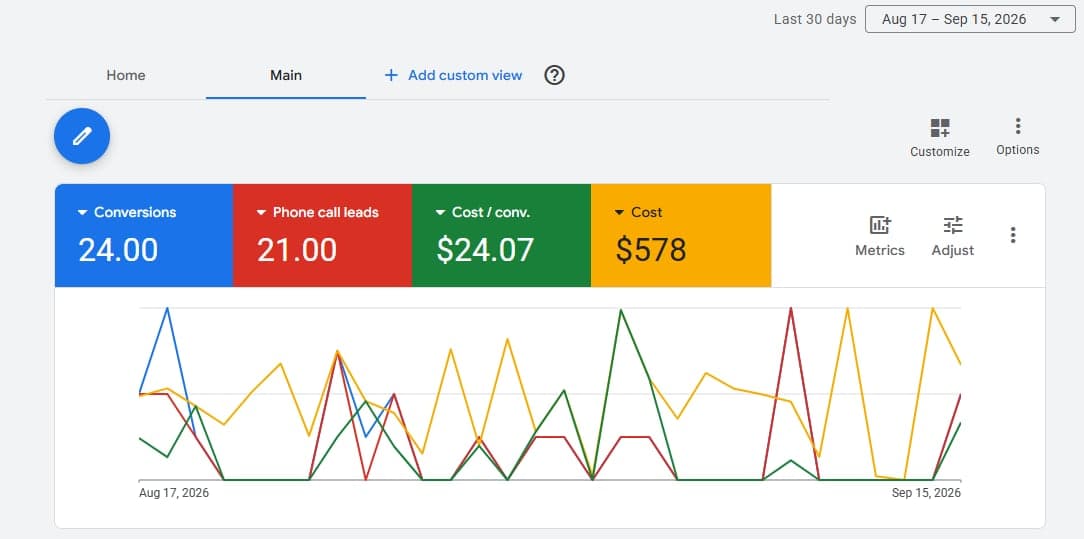
How Adlyvo helps: Lead-quality and outcome feedback can inform decisions where available.From Aug 17 to Sep 15, 2026, this dental Google Ads campaign generated 24 conversions, including 21 phone call leads, at an average $24.07 cost per conversion with $578 in ad spend. Account and campaign names are cropped out of the screenshot.
Each type of search behaves differently, so the ad, the page and the tracking are built for that intent.
 Treatment
High-value, high-intent. Gets its own campaign and a consultation-focused page, so budget is not shared with routine check-ups.
 Urgency
Time-sensitive. Needs a fast call path, tight service-area targeting and call tracking.
 Location
Local and comparison-driven. Works when the ad, the page and the front desk all point to the same next step.
Examples of search intent, not exact keywords or guaranteed results.
Ad spend and results depend on your location, competition and treatments. We do not promise fixed outcomes.

It depends on your location, the treatments you want to grow, competition for those searches and the value of a new patient. We review these before recommending a budget.
Ad spend is separate from management and goes directly to Google. There is no fixed number that suits every practice.
We cannot promise a cost per lead or a timeline. Early work is about learning which searches bring the right patients.
Campaigns follow the treatments you want to grow, not one broad dental account.
Calls, forms and booking actions are tested so the numbers can be trusted.
Search terms and enquiries are reviewed, so quality is visible and not only volume.
You get plain-language priorities based on your account, not a generic playbook.

Founder & Owner
Ahasan focuses on helping businesses turn paid traffic into measurable leads. For dental clinics that means connecting treatment-focused Google Ads with accurate call and form tracking, conversion-focused landing pages and lead follow-up visibility, so the campaign can be judged on enquiries and bookings.
Meet the ownerIt depends on your location, the treatments you want to grow, competition for those searches and the value of a new patient. We review these before recommending a budget. Ad spend is separate from management, and starting prices are shown on this page.
Yes. Campaigns are separated by treatment and search intent, so you can focus budget on the treatments you want most instead of one broad dental campaign.
We cannot promise a timeline. Campaigns can start receiving clicks once live, but how quickly good enquiries arrive depends on budget, competition, your location and tracking. Early work is about learning which searches bring the right patients.
Yes. Local targeting reflects where your practice can realistically serve patients, which reduces clicks from people outside your area.
Yes. Calls, forms and booking actions can be measured, and lead-quality or offline outcome feedback can inform decisions where you can share it.
Let's review the search demand, the campaign structure, the tracking and the landing experience, and show where spend goes to low-value enquiries.