How Google Ads works for aesthetic and beauty businesses
Google Ads places a business in front of people at the moment they search for a treatment or service, so the demand already exists. The advertiser chooses which searches to appear for, what the ad says and where the click lands, and pays when people click. For an aesthetic clinic, spa or salon, the result depends on what happens after the click as much as on the ad itself.
A useful way to think about it is as a chain, where a weakness at any step limits the result. The business, not the ad platform, decides what counts as a qualified enquiry, a booking and a completed service:
- Treatment searchA person looks for a treatment
- Google adMatched to the treatment
- Treatment landing pageRelevant, one clear next step
- Call / form / booking requestThe route they choose
- Conversion trackingRecorded with its source
- Lead reviewChecked for fit and location
- Qualified enquiryMeets the business's own criteria
- Booking / business outcomeDecided by the business
Google Ads for aesthetic clinics and beauty businesses: how Adlyvo works
Why search intent matters
People who search are at different points. Some are looking for a specific treatment or service, some are comparing providers and some are only researching. Intent decides whether a click is likely to become an enquiry, so a campaign built around higher-intent searches usually serves a business better than one built around general beauty topics.
Searchers also use different names for similar providers, such as aesthetic clinic, med spa or beauty salon. Intent is read from what a person is looking for and where, not from the label they use.
Choosing services and treatments to advertise
Not every service deserves equal budget. Categories that businesses of this kind commonly promote include laser treatments, skin treatments, spa services, hair salon services and other aesthetic services. The choice depends on:
- The services the business actually offers and wants to grow.
- Where it can serve clients.
- Demand and competition for each service.
- Capacity to handle new enquiries and bookings.
- The value of a new client and the business's economics.
- Advertising rules that apply to the service.
This guide makes no claim about the result of any treatment, and nothing here implies an outcome.
Campaign structure
Campaigns that follow the services a business wants to grow let each priority service have its own budget, ads, landing page and reporting. A single general account blends different services together, which hides what each produces and lets cheap clicks take budget from valuable ones. Small or closely related services can be grouped where volume is low, since too many tiny campaigns have their own cost.
Search intent and keywords
Searches can be read as higher or lower intent. This is a conceptual guide, not a keyword list.
Higher-intent searches usually look like:
- Searching for a specific service or treatment.
- A service or treatment plus a location.
- Looking for a local clinic, salon or provider.
- Consultation intent.
- Appointment or booking intent.
Lower-intent searches usually look like:
- Do-it-yourself and at-home methods.
- Jobs and careers.
- Courses and training.
- Product-only searches.
- Definitions.
- General research.
No search volumes or costs are given here, since they vary by service and location.
Location targeting
Geography matters because clients usually need to be able to attend. Enquiry quality can suffer when:
- Ads reach people outside the business's service area.
- The searcher is looking in a different city or location.
- The service is not available at the location that person means.
- The person is looking for another type of provider or service.
There is no universal targeting radius. The business defines where it genuinely serves clients, and targeting, exclusions and search-term reviews should follow that definition.
Service-specific ads
Ad messaging should name the service or treatment and the location clearly and set honest expectations for what the person will find. It should avoid outcome claims, guarantees, before-and-after claims and price claims that the business cannot stand behind. Advertising rules differ by service and region and should be checked with the business's own compliance guidance.
Negative keywords
Negative keywords stop ads showing for searches that do not fit. Common categories of irrelevant searches include:
- Jobs and careers.
- Training and courses.
- Do-it-yourself methods.
- Products rather than services.
- Treatments or services the business does not offer.
- Locations the business does not serve.
- Unrelated intent.
Not every word should automatically be excluded. A term that looks irrelevant can sometimes come from a person who is ready to book, so negatives are best decided from real search-term data.
Landing pages
Sending a service-specific ad to a relevant service landing page is generally more useful than sending it to a generic homepage, because the visitor lands on the thing they searched for. A useful service page includes:
- Service or treatment relevance: the page matches what was searched.
- The location.
- A clear call to action.
- A phone number.
- An enquiry form.
- A consultation or booking request, where the business takes them.
- Mobile usability.
- Genuine trust signals the business already has and can stand behind.
A landing page should not invent practitioner credentials, treatment outcomes, guarantees, before-and-after claims, review counts or prices.
Landing pages built for paid traffic
Calls, forms and consultation or booking requests
People reach out in different ways, and each route should be captured and measured. A phone click is not an actual call. A form submission is not automatically a useful enquiry, and a consultation or booking request is not a confirmed appointment. Which routes matter most depends on the service and how the business takes bookings.
How Google Ads call tracking works
Conversion tracking
Tracking should not be judged on clicks alone. These are different events, and none should be treated as interchangeable:
| Event | What it is | How it is judged |
|---|---|---|
| Ad click | Someone clicked an ad. | Shows interest in the search, nothing more. |
| Phone click | A tap on a phone number. | Shows intent to call. Often a Secondary signal. |
| Actual call | A call that was placed and connected. | Measured through call settings or a call-tracking setup. |
| Form submission | A confirmed enquiry form. | Counted on the confirmed submission, not the button click. |
| Consultation or booking request | A request was submitted. | A request, not a confirmed appointment. |
| Qualified enquiry | A valid enquiry that fits the business. | Judged by the business, with the outcome recorded safely. |
| Confirmed appointment | An appointment that was scheduled. | The business's own outcome, outside the ad platform. |
| Completed service or treatment | The service that took place. | Known to the business only, not the ad platform. |
Useful signals may include meaningful completed calls, completed enquiry forms, consultation requests, booking requests and, where reliable downstream feedback exists, qualified enquiries.
Google Ads conversion tracking for lead generation
Google Ads conversion tracking service
Aesthetic and beauty conversion tracking: calls, forms and qualified enquiries
Primary vs secondary conversions
Google Ads lets you decide which conversion actions guide bidding (primary) and which are observed (secondary). The table below shows how actions might be classified. It is an illustration, not a universal rule.
Illustration, not a universal classification
| Action | Potential role | Why |
|---|---|---|
| Meaningful completed call | Potential primary | A call that met a meaningful standard is closer to an enquiry than a tap. |
| Completed enquiry form | Potential primary | A confirmed submission, ideally tied to a treatment page. |
| Consultation or booking request | Potential primary | A clear step when it can be measured. |
| Qualified enquiry | Potential primary | A deeper signal where reliable downstream data exists. |
| Phone button click | Potential secondary | A tap, not a confirmed call. |
| CTA or booking button click | Potential secondary | A step toward a request before completion, not a request. |
| Form start | Potential secondary | Started, not submitted. |
| Contact page visit | Potential secondary | Shows interest, not an enquiry. |
| Other micro-actions | Potential secondary | Context that helps read behaviour, not an enquiry. |
The right classification depends on the business's objective, tracking method, data reliability, conversion volume, booking process and campaign goal.
Primary vs secondary conversions in Google Ads
Qualified enquiries
Not every enquiry is useful to a business. Generic reasons an enquiry may not be useful include:
- The wrong service or treatment.
- Outside the service area.
- An unavailable service.
- Product-only intent.
- Training or job intent.
- Spam.
- A duplicate enquiry.
- A research-only enquiry.
- An existing customer or a support request.
- Another business-defined mismatch.
The business defines qualification. Adlyvo does not decide whether an enquiry becomes a consultation, an appointment, a customer or a treatment outcome.
How qualified lead tracking works
Budget considerations
There is no universal budget for aesthetic clinics or beauty businesses. What a business should spend depends on:
- The service or treatment.
- The geography.
- Competition for those searches.
- Expected cost per click.
- Conversion rate from click to enquiry.
- Desired enquiry volume.
- Qualified-enquiry rate.
- Capacity to handle enquiries.
- Business economics.
No cost-per-click or cost-per-lead benchmarks are offered here, because they vary too much by service and location to generalize. Ad spend is separate from management fees, which are listed on the pricing page.
Search-term optimization
Reviewing the search terms that actually triggered ads is one of the most useful routine jobs in an account. It shows which searches produce enquiries, which are wasted budget and which new terms deserve their own coverage, and it feeds the negative-keyword list. It should be done on an ongoing basis, with changes made when there is enough data to act on.
Enquiry-quality review
Enquiry quality is judged by looking at what happened to the enquiries: how many were valid, fit the service and location, and became consultation or booking opportunities. A campaign can produce many cheap enquiries that rarely become bookings, so quality should be reviewed alongside volume. Follow-up also matters, because an enquiry that goes unanswered is a cost with no outcome.
AI lead and appointment automation
Aesthetic and beauty lead generation: from enquiry to booking opportunity
Privacy and the clinical boundary
A beauty salon or spa and a clinic that provides medical or clinical aesthetic services are different contexts, and measurement should reflect that. Enquiries to a clinic may contain health-related information, so tracking should be designed with care. Advertising and measurement systems should avoid unnecessarily sending data such as the following into advertising platforms:
- Diagnoses.
- Symptoms.
- Health history.
- Medications.
- Detailed treatment history.
- Detailed medical messages.
- Sensitive appointment information.
Measurement should focus on appropriately limited signals, such as whether an enquiry occurred, the source and campaign context and, where permitted and correctly configured, a safe downstream status.
Follow applicable privacy requirements, platform policies, consent requirements and the business's own legal and compliance guidance.
Common PPC mistakes
- Broad or irrelevant searches.
- Product traffic.
- Training and jobs traffic.
- Poor location targeting.
- Mixing unrelated treatments or services together.
- Generic homepage traffic.
- Weak negative-keyword management.
- Phone clicks counted as calls.
- Booking clicks counted as bookings.
- Form submissions treated as qualified enquiries.
- Duplicate conversions.
- No service or treatment context.
- No enquiry-quality review.
- No search-term review.
- Judging campaigns only by cost per lead.
- Scaling before enquiry quality is understood.
An example campaign structure
An educational example, not a real account. Each priority service gets its own campaign, and each campaign follows the same path from search to a reviewed enquiry:
Educational example, not a universal account structure
Aesthetic / beauty Google Ads
- Laser treatments
- Skin treatments
- Spa services
- Hair salon services
- Service / treatmentThe service the business wants more of
- Search intentWhat the person is looking for
- LocationWhere the business can serve clients
- KeywordsSpecific and place-aware
- AdNames the treatment and area
- Relevant landing pagePhone, form or consultation request
- Call / form / consultation requestHow the person reaches out
- Lead reviewChecked for fit and location
How to judge performance
Useful metrics, read together, include clicks, cost per click, calls, forms, consultation requests, booking requests, conversions, conversion rate, cost per conversion, valid enquiries, qualified enquiries and, where reliable data exists, cost per qualified enquiry. No benchmarks are given, because what is good varies by service and location.
A lower cost per lead does not automatically mean better enquiries. A campaign can produce cheap enquiries that rarely fit the business, so cost is best read alongside qualification and booking outcomes.
A real beauty and aesthetic Google Ads snapshot
For context, here is one real, anonymized beauty and aesthetic Google Ads account over one 30-day reporting period, Sep 12 – Oct 11, 2026: 215.51 tracked conversions, 375 phone calls, £17.81 cost per conversion and £3.84K ad spend, as the dashboard reported them.
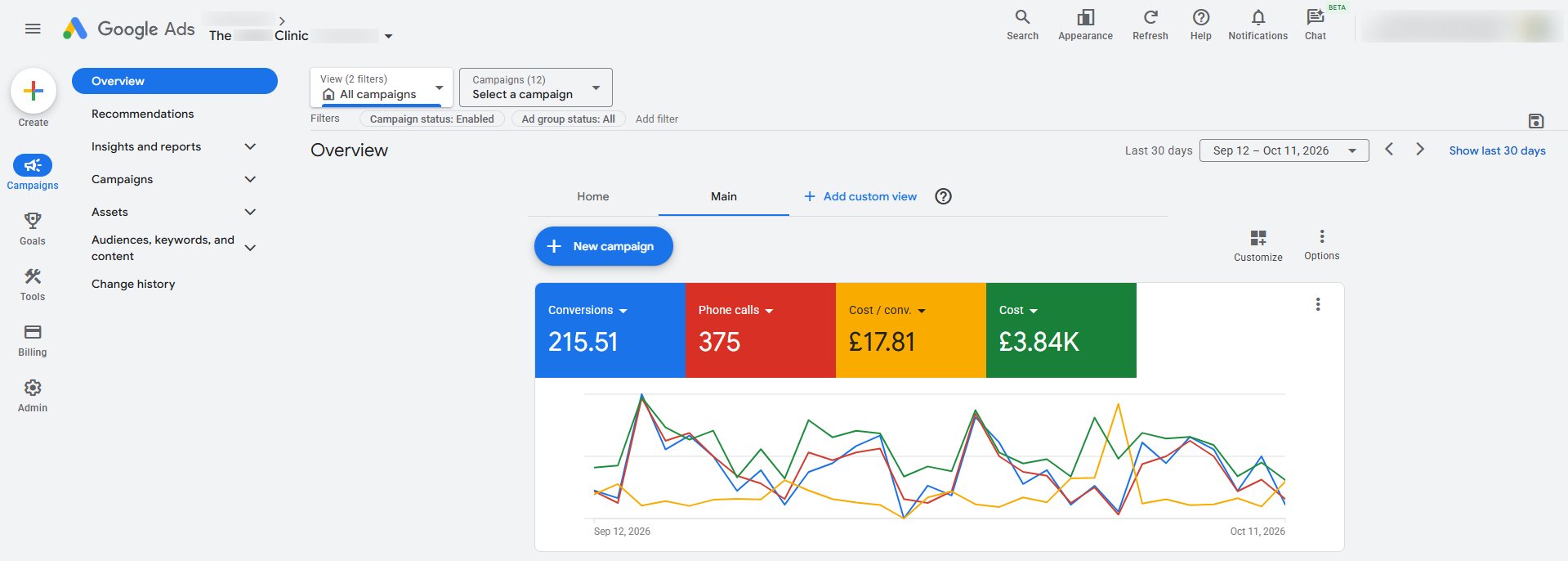
Tracked conversions and phone-call activity are not being presented as confirmed appointments, qualified enquiries or completed treatments. They are advertising metrics, and each one still needs downstream review. This is one account over one period, not a benchmark.
Beauty and aesthetic Google Ads: how Adlyvo works, with the full account snapshot
A worked example (hypothetical numbers)
The numbers below are a hypothetical educational example, not an Adlyvo client result. Imagine one campaign over a period produced:
Hypothetical example, not an Adlyvo client result
- Ad clicks150
- Enquiries26
- Valid enquiries20
- Service / location-fit enquiries14
- Qualified enquiries9
- Consultation / booking opportunities5
The 26 enquiries do not automatically mean 26 useful bookings. Only 20 were valid, 14 fit the service and location, 9 were qualified and 5 became consultation or booking opportunities. Judging the campaign on clicks, or even on enquiries, would hide that difference. No spend, cost per lead, revenue, return or treatment value is implied.
How Adlyvo approaches aesthetic and beauty Google Ads
- Understand the services or treatments and the service area.
- Identify high-intent demand.
- Structure meaningful categories separately where appropriate.
- Match ads with relevant landing pages.
- Track meaningful calls, forms and consultation requests.
- Distinguish Primary and Secondary signals.
- Review search terms.
- Review enquiry quality where reliable data exists.
- Optimize around measurable outcomes.
Adlyvo publishes performance examples only where the underlying result has been approved for publication.
Google Ads for aesthetic clinics and beauty businesses: commercial overview
Verified account results with tracked calls and conversions
How Adlyvo works as a Google Ads specialist
Frequently Asked Questions
Does Google Ads work for aesthetic clinics?
It can, because it reaches people at the moment they search for a treatment or service. Results depend on search intent, location, structure, landing-page relevance, tracking, enquiry quality and follow-up, and are not guaranteed.
Does Google Ads work for beauty salons?
It can for salons that serve a local area and are searched for by service. The same conditions apply: specific campaigns, a relevant page, an easy way to call or book and tracking that shows which ads produced real enquiries. No outcome is guaranteed.
Does Google Ads work for spas?
It can, where people search for the spa services on offer and the business can serve them locally. Results depend on intent, location, page relevance, booking path and tracking, and are not guaranteed.
How should aesthetic clinics choose Google Ads keywords?
By starting from the services the clinic offers and the way people describe them, favouring specific and local searches, and then refining from real search-term data. Irrelevant, DIY and research-only terms are excluded rather than chased.
Should different treatments or services use separate campaigns?
Often, yes. Services differ in search intent, consideration and value, so separating priority services lets each have its own budget, ads, landing page and reporting. Small or closely related services can be grouped where volume is low.
How should locations be targeted?
Around where the business can genuinely serve clients, as the business defines it. There is no universal radius, and location settings, exclusions and search-term reviews should all follow the real service area.
Should aesthetic ads use dedicated landing pages?
Usually. A page about the treatment or service searched, in the right location, with a clear phone number and consultation or booking request, is more relevant than a general homepage. It should use only trust signals that genuinely exist.
Can phone calls be tracked?
Yes. Calls from ads and from a website can be measured, and a tapped number should be kept separate from a connected call. The content of calls is not needed to judge campaign results.
Can consultation requests be tracked?
Often. A submitted consultation request on the website can be recorded as a conversion, ideally on a confirmed submission or thank-you step. A request is not a completed consultation or treatment.
Can booking requests be tracked?
Often. A completed booking request can be recorded as a conversion, and a booking in a connected system may be measurable. A click on a booking button is a weaker, separate signal, and bookings made by phone or elsewhere may need to be recorded by the business.
Can Google Ads track qualified enquiries?
Where the business records which enquiries were genuine and relevant and that status can be shared back safely, it can be used to judge campaigns. It requires reliable downstream data, is not automatic and should not include sensitive health details.
How much should an aesthetic clinic spend on Google Ads?
There is no universal figure. It depends on the service, geography, competition, cost per click, conversion rate, target volume, qualified-enquiry rate, capacity and business economics.
How much do Google Ads cost for aesthetic clinics?
Cost has two parts: ad spend, which goes to Google and depends on competition and how many clicks are wanted, and management fees. Click costs vary by treatment, location and competition, so no universal figure is given. Management prices are on the pricing page.
Google Ads vs SEO for aesthetic clinics?
They do different jobs. Google Ads can reach people searching for a treatment now and is measurable by campaign, but it stops when spend stops. SEO builds organic visibility over a longer period. Many businesses use both, and the mix depends on timing, budget and competition.
Google Ads vs Meta Ads for aesthetic businesses?
Google search ads respond to people actively searching for a treatment or provider. Meta ads reach people by interest and audience before they search, which is a different intent and often a different job. The right channel depends on goals and offer.
How often should campaigns be optimized?
Regularly, with search terms and tracking reviewed on an ongoing basis and changes made when there is enough data to act on. Reacting to a day or two of results can do more harm than good, and no single schedule fits every account.
Related resources and services
Aesthetic and beauty Google Ads: commercial overview
Google Ads call tracking guide
Google Ads qualified lead tracking guide