What transportation conversion tracking means
Transportation conversion tracking is the practice of recording the actions that matter to a transportation business, such as phone calls, enquiry forms and booking requests, and connecting them to the campaign, service and page that produced them. Without it, a campaign can only be judged on clicks and impressions, which say little about the enquiries a business actually receives.
Why clicks are not enough
A click shows interest in a search. It does not show that the person called, that the call connected, that the pickup area and destination are ones the business covers, or that they wanted a service it provides. A campaign can generate many clicks and few useful enquiries, and the reverse. Only the actions after the click describe what a campaign produced.
Which actions should be measured
The actions worth measuring are the ones where a person genuinely reaches out or commits:
- Phone calls, especially calls long enough to be a real conversation.
- Completed enquiry forms.
- Submitted booking requests.
- Confirmed bookings, where they can be measured reliably.
- Qualified booking enquiries, where the business can record that outcome.
Weaker signals, such as page views and simple booking-button clicks, are useful context but should not be mistaken for enquiries.
Phone calls
For many transport services, particularly near-term ones, the phone can be the main route to a business, so call measurement carries a lot of weight and is often misread.
A tap on a phone number, a connected call, a valid enquiry, a qualified booking enquiry, a confirmed booking and a completed trip are all different things:
| Event | What it is | How it is judged |
|---|---|---|
| Phone click | A tap on a phone number on the website. | Shows intent. Often a Secondary signal. |
| Actual call | A call that was placed and connected. | Measured through call settings or a call-tracking setup. |
| Booking CTA click | A tap on a booking button. | An early signal, not a booking request. |
| Booking request | A confirmed booking or quote submission. | Counted on the confirmed submission, not the click. |
| Valid enquiry | A real customer with a real enquiry. | Not spam, a duplicate or a wrong number. |
| Qualified booking enquiry | A valid enquiry that fits the business. | Judged by the business, with the outcome recorded. |
| Confirmed booking | A trip that was confirmed. | The business's own outcome, outside the ad platform. |
| Completed trip | A trip that took place. | Known to the business only, not the ad platform. |
Call-duration thresholds can help separate very short calls from real conversations, but only conceptually. There is no single duration that is right for every business, and call length is a proxy for quality, not proof of it.
How Google Ads call tracking works
Forms and enquiry submissions
A form submission proves only that the form was submitted. It does not automatically prove:
- A supported pickup area.
- A supported destination.
- An available route.
- A valid enquiry.
- A qualified booking enquiry.
- A confirmed booking.
- A completed trip.
This is why downstream review matters. The submission is where measurement starts, not where it ends.
Booking requests
A booking journey has stages, and they should not automatically be treated as one conversion:
- Booking CTA clickA tap on a booking button
- Booking form startedThe form was opened or begun
- Booking request submittedA confirmed submission
- Availability / route reviewThe business checks the trip
- Booking confirmedThe business accepted it
- Trip completedKnown to the business only
Counting a started form or a button click as a booking request overstates results. Not every business has online booking, so a measurable booking step may not exist on the website at all. Where bookings are made by phone or in another system, the business may need to record them itself.
Confirmed bookings
A booking request is not a confirmed booking. A request is a customer asking, while a confirmed booking means the business has checked availability and the route and accepted it. Confirmation usually happens outside the website, so it is measurable only if the business records it and can share that status safely. A confirmed booking is also not a completed trip.
Location and route context
Location and route context is the most transportation-specific part of measurement. A tracked enquiry can still be low value if:
- The pickup area is unsupported.
- The destination is outside coverage.
- The route is unavailable.
- The service zone is wrong.
- The business cannot serve the trip.
- The enquiry is for another transportation type.
The business defines:
- Pickup coverage.
- Destination coverage.
- Route availability.
- Service zones.
There is no universal targeting radius. Measurement benefits from location and route context that lets results be read against what the business can actually run.
Landing pages built for paid traffic
Primary vs secondary conversions
Google Ads lets you decide which conversion actions guide bidding (primary) and which are observed (secondary). The table below shows how transportation actions might be classified. It is an illustration, not a universal rule.
Illustration, not a universal classification
| Transportation action | Potential role | Why |
|---|---|---|
| Meaningful completed call | Potential primary | A call that met a meaningful standard is closer to an enquiry than a tap. |
| Completed enquiry form | Potential primary | A confirmed submission, ideally tied to a service page. |
| Submitted booking request | Potential primary | A clear step when it can be measured. |
| Confirmed booking | Potential primary | A stronger signal where it can be measured reliably. |
| Qualified booking enquiry | Potential primary | A deeper signal where reliable downstream data exists and outcomes are plentiful. |
| Phone button click | Potential secondary | A tap, not a confirmed call. |
| Booking CTA click | Potential secondary | A step toward a request before completion, not a request. |
| Contact page visit | Potential secondary | Shows interest, not an enquiry. |
| Form start | Potential secondary | Started, not submitted. |
| Booking form start | Potential secondary | Started, not submitted. |
| Other micro-actions | Potential secondary | Context that helps read behaviour, not an enquiry. |
The right classification depends on the business objective, tracking method, reliability, conversion volume, booking process and campaign goal.
Primary vs secondary conversions in Google Ads
Phone click vs actual call
A phone click and an actual call measure different things. A click records that someone tapped a number, often on a mobile screen. An actual call records that a call was connected, and may be measured through call settings, a tracking number or a call-tracking setup. Treating them as equivalent inflates enquiry counts, because a tap does not always become a call, and a call can come from someone who never clicked a tracked number.
Raw enquiry vs qualified booking enquiry
The path from contact to opportunity has stages, and each filters further:
- Raw enquiry: someone made contact.
- Valid enquiry: a real customer, not spam or a duplicate.
- Service fit: the request is for a service the business offers.
- Route and coverage fit: the pickup, destination and route are covered.
- Qualified booking enquiry: it meets the business's own criteria.
- Booking opportunity.
- Business-determined outcome.
Qualified-enquiry measurement requires reliable downstream data: the business has to record what happened to each enquiry. It is not automatic, and Adlyvo does not decide whether a trip should be accepted.
How qualified lead tracking works
Google Ads, Google Tag Manager and GA4
Three tools are often involved, each with a distinct role:
- Google Tag Manager helps deploy and manage the tracking tags on the website.
- GA4 can measure website behavior and events.
- Google Ads uses conversion actions for advertising measurement and optimization.
GA4 is not always the conversion source for Google Ads. Which route is used should be a deliberate, consistent choice, so the same outcome is not recorded twice.
Google Ads conversion tracking for lead generation
Google Ads conversion tracking service
Duplicate conversion risks
Duplicates make results look better than they are. Examples include:
- The same form tracked directly and also imported from GA4.
- A phone click and an actual call counted as equivalent enquiries.
- A booking CTA click and a submitted booking request counted as the same outcome.
- A booking request and a confirmed booking treated as identical.
- A form start and a form submit both treated as lead conversions.
- Browser and server events without correct deduplication.
- Old conversion actions left as Primary.
Server-side conversion tracking and deduplication
Qualified-enquiry feedback
Qualified-enquiry feedback closes the loop: the business records which enquiries were valid, fit the service and route and became booking opportunities, and that outcome is used to judge campaigns. It requires a consistent way of recording outcomes and enough volume to be meaningful. Where it exists, it is the most useful signal a transportation campaign can have.
How offline conversion import sends outcomes back
An example transportation measurement flow
A typical flow for a transportation campaign looks like this. Each step is a handoff where information can be lost:
- Ad clickA person clicks a Google ad
- Relevant landing pageMatched to the service
- Contact actionThe person decides to reach out
- Call / form / booking requestThe route they choose
- Enquiry recordedStored with its source
- Route / coverage reviewChecked for fit and coverage
- Qualified booking enquiryMeets the business's criteria
- Booking / trip opportunityDecided by the business
A worked example (hypothetical numbers)
The numbers below are a hypothetical educational example, not an Adlyvo client result. Imagine one campaign over a period produced:
Hypothetical example, not an Adlyvo client result
- Forms / booking requests65
- Valid enquiries48
- Route / service-fit enquiries34
- Qualified booking enquiries23
- Booking opportunities14
- Confirmed bookings9
If the campaign is optimized only toward the 65 raw enquiries, it cannot tell the 9 confirmed bookings from the 56 enquiries that did not reach one. Optimizing toward raw enquiries can hide major differences in booking quality. A confirmed booking is also not a completed trip. No spend, cost per lead, revenue, return or trip value is implied.
Common tracking mistakes
- Page views used as lead conversions.
- Every CTA click made Primary.
- Phone clicks counted as actual calls.
- Form starts counted as completed forms.
- A booking CTA click counted as a booking request.
- A booking request counted as a confirmed booking.
- Duplicate form conversions.
- GA4 and direct Google Ads duplicates.
- No route or location context.
- Unsupported routes counted as useful leads.
- No enquiry-quality review.
- Test submissions contaminating data.
- Old conversion actions left Primary.
- No verification after website changes.
- Judging campaigns only by raw enquiry count.
- Assuming every enquiry is qualified.
- Assuming every booking request becomes a completed trip.
When advanced tracking may be useful
Simpler tracking may be enough for many transportation businesses: reliable call and form conversions, clearly classified as primary or secondary, with a regular review of enquiry quality. More advanced measurement may be useful where a business needs to see what happens after the first contact. It can include:
- Qualified-enquiry feedback.
- Offline conversion import.
- Server-side measurement.
- CRM booking-status feedback.
These add complexity, depend on reliable data and need enough volume to be meaningful, so they are worth considering where there is a real measurement gap. Not every transportation business needs them.
How offline conversion import works
When server-side tracking is worth using
A verified transportation example
Adlyvo's published transportation example is a private transport operator account running a Performance Max campaign: 754 tracked conversions from 19,200 clicks over an 8-month period, shown directly from the account. Reporting is shown in the account's local currency (SGD).
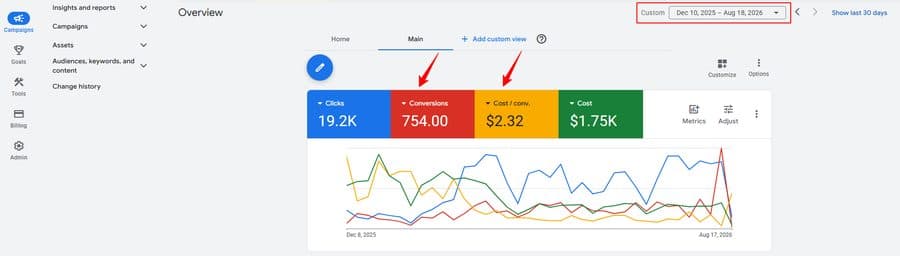
This is one account over one reporting period, not a benchmark. Those conversions are not being claimed as confirmed bookings, qualified booking enquiries or completed trips.
Transportation Google Ads: how Adlyvo works with transportation businesses
How Adlyvo approaches transportation conversion tracking
- Understand the service and the booking journey.
- Define the meaningful conversion actions.
- Distinguish calls, forms and booking requests.
- Separate Primary and Secondary signals.
- Verify tracking with real tests.
- Avoid duplicate conversions.
- Preserve source, location and route context where practical.
- Use downstream enquiry-quality feedback where reliable.
- Connect measurement to campaign optimization.
Google Ads for transportation services: the full guide
Transportation lead generation guide
Frequently Asked Questions
What should a transportation business track as a conversion?
Meaningful actions: calls that are real conversations, completed enquiry forms and submitted booking requests, plus confirmed bookings and qualified booking enquiries where they can be measured reliably. Page views and booking-button clicks are weaker signals.
Should phone calls be Primary conversions?
Calls that meet a meaningful standard are often good Primary candidates, while a simple tap on a number is usually better kept Secondary. It depends on the business, the service and the tracking method.
Is a phone click the same as an actual call?
No. A phone click is a tap on a number. An actual call is a call that connected, and a valid or qualified enquiry is a further step beyond that.
Can transportation enquiry forms be tracked?
Yes. A completed form can be recorded as a conversion and tied to the campaign and page that produced it.
Can booking requests be tracked?
Often, where the business takes booking requests through its website. A submitted request can usually be recorded as its own conversion. Bookings made by phone or elsewhere may need to be recorded by the business.
Is a booking CTA click the same as a booking request?
No. A CTA click is an early signal. A started form and a submitted request are later, separate stages.
Is a booking request the same as a confirmed booking?
No. A request is the customer asking. A confirmed booking means the business has accepted it, and a completed trip is a further step.
Should form submissions always be Primary conversions?
Not always. A completed enquiry form is often a strong candidate, but a submission does not prove the enquiry is valid or qualified. Classification depends on volume, reliability and objectives.
Can Google Ads track qualified booking enquiries?
Where the business records which enquiries qualified and that outcome can be shared back, yes. It requires reliable downstream data and is not automatic.
Can route or location context be tracked?
Often, through landing pages, campaigns or non-sensitive form context. It does not require every business to use separate forms.
How do transportation businesses avoid duplicate conversions?
Count each real outcome once: use one tracking path per conversion, keep clicks, starts and completed actions in separate actions, remove old actions and deduplicate browser and server events if both exist.
Do transportation businesses need server-side tracking?
Not by default. It is worth considering only where browser-side measurement has a real gap, and it adds complexity.
How often should transportation conversion tracking be checked?
Regularly, and after any change to the website, forms or phone setup. Tracking can break quietly, so periodic test enquiries and call tests are worthwhile.
Related resources and services
Google Ads for transportation services guide
Transportation lead generation guide
Google Ads call tracking guide