What transportation lead generation means
Transportation lead generation is the process of turning demand for a transport service into booking enquiries a business can assess and act on. It includes the traffic, the page that traffic lands on, how enquiries are captured and measured, how they are qualified and what happens afterwards. Getting clicks is one small part of it.
A stronger system connects every step, because a weakness at any one of them limits the result:
- Transport demandSearches for a transport service
- Paid trafficMatched to the search
- Relevant landing pageRelevant, one next step
- Call / booking requestHow the customer reaches out
- Enquiry trackingRecorded with its source
- QualificationChecked for service and route
- Follow-upA timely response
- Booking / trip opportunityDecided by the business
Enquiry volume vs enquiry quality
More enquiries are not always better. A business that receives many requests for pickup areas or destinations it does not cover, for services it does not offer or from people who are only researching has a volume that feels like progress and produces little. Enquiry quality matters as much as enquiry volume, and fewer, better-matched enquiries are often worth more than many poor ones.
Choosing transport services and intent to promote
Not every service or type of intent deserves equal budget. Priority may depend on:
- The services the business actually offers.
- The locations and routes it covers.
- Search demand.
- How soon trips are usually needed.
- Competition.
- Available budget.
- Booking capacity.
- Enquiry quality.
- Business economics.
No cost-per-click, cost-per-lead, trip value or revenue figures are given here, since they vary too much between services and areas to generalize.
Understanding transportation search intent
People searching for transport are at different points, and their searches show it.
Higher-intent searches usually look like:
- A transport service need.
- Pickup and destination relevance.
- A route-specific need.
- Booking intent.
- Near-term trip intent.
- Scheduled trip intent.
Lower-intent searches usually look like:
- Jobs and careers.
- Training.
- Definitions.
- General research.
- Unsupported locations.
- Unrelated transportation modes.
- Informational-only searches.
Lower-intent traffic is not meaningless, but it rarely belongs in a campaign built to produce enquiries.
Google Ads as a lead-generation channel
Google Ads is a lead-generation channel because it reaches people at the moment they search, so the demand already exists. It is not the only channel, and it does not produce enquiries by itself. Its value depends on the quality of everything it connects to.
How Google Ads works for transportation businesses
Service and route campaign structure
Campaigns separated by service or intent let each priority have its own budget, ads, page and goal. A single general account blends different services and kinds of demand together, which hides what each produces and lets cheap clicks take budget from valuable ones. Smaller services can be grouped where volume is low.
Location and route context
Location and route context is one of the biggest influences on enquiry quality in transportation, because a request is only useful if the business can run the trip. Enquiries may be low quality when:
- The pickup area is unsupported.
- The destination is outside coverage.
- The route is unavailable.
- The service zone is wrong.
- The business cannot serve the trip.
- The person wanted another transport service.
The business defines what it covers:
- Pickup areas.
- Destination coverage.
- Route availability.
- Service zones.
There is no universal targeting radius. Targeting, exclusions and search-term reviews should follow the coverage the business actually has.
Immediate vs scheduled demand
Some transportation enquiries may be immediate or near-term, where someone needs a trip soon. Others are scheduled in advance, where someone is arranging a future trip and comparing options. That can affect:
- Whether people phone or use a booking form.
- The call to action.
- The landing-page content.
- How urgent a response needs to be.
- The booking process.
Not every enquiry is urgent, so urgency should not be assumed.
Landing pages
Sending a relevant transportation ad to a service or route landing page is generally stronger than sending it to a generic homepage. A good page includes:
- Transport service relevance: the page matches what was searched.
- Pickup and destination context.
- Route coverage.
- A clear call to action.
- A phone number.
- A booking request.
- An enquiry or quote form.
- Useful service information.
- A fast, easy mobile experience.
- Genuine trust signals that already exist.
A landing page should not invent fleet size, licences, guaranteed arrival times, pricing guarantees, vehicle availability, review counts or service guarantees.
Landing pages built for paid traffic
Calls, forms and booking requests
People reach out in different ways, and each route should be captured and measured. A phone click is not an actual call. An actual call is not a valid enquiry, a valid enquiry is not a qualified booking enquiry, and a qualified booking enquiry is not yet a confirmed booking or a completed trip.
A form submission is not automatically a useful enquiry. A booking CTA click is not a booking request, and a booking request is not a confirmed booking.
How Google Ads call tracking works
Conversion tracking
Lead generation should not be judged only on traffic. Useful measurements may include:
- Calls.
- Forms.
- Booking requests.
- Quote requests, where relevant.
- Valid enquiries.
- Qualified booking enquiries.
- Route and location context.
- Cost per conversion.
- Cost per qualified enquiry, where reliable data exists.
Which of these are practical depends on the business and the tracking setup, and no benchmarks are offered here.
Primary vs secondary conversions in Google Ads
Google Ads conversion tracking
Google Ads conversion tracking service
Transportation conversion tracking: calls, booking requests and qualified enquiries
Qualified booking enquiries
An enquiry passes through stages, and each stage filters further. The transportation business defines availability, route fit, qualification, booking acceptance and trip outcome. Adlyvo does not decide whether a trip should be accepted.
| Stage | What it is | What it requires |
|---|---|---|
| Contact action | A call, form, booking request or booking click. | Shows that someone reached out. |
| Enquiry | A contact that was received. | Recorded with its source. |
| Valid enquiry | A real customer with a real enquiry. | Not spam, a duplicate or a wrong number. |
| Service fit | The request is for a service the business offers. | Checked against the business's services. |
| Route / coverage fit | The pickup, destination and route are covered. | Checked against the business's real coverage. |
| Qualified booking enquiry | Meets the business's own criteria. | Qualification is the business's decision. |
| Booking opportunity | A booking was arranged or quoted. | A confirmed next step. |
| Trip outcome | Whether the trip went ahead. | The business's own outcome, outside the ad platform. |
Generic reasons an enquiry may not be useful include:
- An unsupported pickup area.
- An unsupported destination.
- An unavailable route.
- The wrong service.
- Spam.
- A duplicate enquiry.
- Price-only research.
- Informational-only intent.
- An existing customer or a support request.
- Another business-defined mismatch.
These are generic examples, and the business sets its own criteria.
How qualified lead tracking works
Follow-up
What happens after an enquiry arrives is part of lead generation. Paid advertising alone cannot compensate for weak or inconsistent follow-up, because an enquiry that goes unanswered is a cost with no outcome. A neutral path looks like this, with each step needing an owner:
- Enquiry receivedThe enquiry arrives
- ResponseSomeone replies or calls back
- Pickup / destination / service checkFit and coverage are confirmed
- QualificationChecked against criteria
- Booking processThe booking is handled
- Booking opportunityThe trip is scoped
- Business-determined outcomeDecided by the business
This is not a judgment of anyone's team. It shows where enquiries are commonly lost, and why making each step visible helps. How a business staffs these steps is its own decision.
AI lead and appointment automation
Response-time considerations
For near-term or high-intent transport enquiries, a timely response can matter, because the customer may be contacting several providers at the same time. This is a qualitative point. No statistics or fixed response-time rules are offered here, since the effect varies by service, location and how people make contact.
Budget allocation
There is no single right transportation lead-generation budget. Consider:
- The service.
- The location.
- Route coverage.
- Competition for those searches.
- Expected cost per click.
- Conversion rate from click to enquiry.
- Target enquiry volume.
- The rate at which enquiries qualify.
- Booking capacity.
- Business economics.
No cost-per-click or cost-per-lead ranges are given. Ad spend goes to Google and is separate from management fees, which are listed on the pricing page.
Measuring enquiry quality
A lower cost per lead does not automatically mean better booking enquiries. A campaign can produce cheap enquiries that rarely become bookings. Enquiry quality is measured by looking at what happened to the enquiries: how many were valid, fit the service and route, qualified and reached a booking opportunity. Where that data exists, it is the most reliable way to compare campaigns.
Common transportation lead-generation mistakes
- Chasing clicks instead of useful booking enquiries.
- Overly broad transportation traffic.
- Unsupported pickup or destination searches.
- Unsupported route searches.
- Wrong transport intent.
- Weak negative-keyword review.
- Overly broad geography.
- Generic landing pages.
- Phone clicks counted as calls.
- Booking CTA clicks counted as confirmed bookings.
- Forms treated as qualified enquiries.
- No location or route context.
- No qualification.
- Weak or inconsistent follow-up.
- Duplicate conversions.
- No search-term review.
- Judging only by cost per lead.
- Scaling before booking quality is understood.
An example booking-enquiry system
Put together, a transportation booking-enquiry system has parts that can each be reviewed: demand from transport searches, a campaign for each priority service, a matching landing page, tracking for calls and booking requests, a way to qualify enquiries, a follow-up process and a record of outcomes that feeds back into decisions.
A worked example (hypothetical numbers)
The numbers below are a hypothetical educational example, not an Adlyvo client result. Imagine one campaign over a period produced:
Hypothetical example, not an Adlyvo client result
- Ad clicks170
- Enquiries30
- Valid enquiries23
- Route / service-fit enquiries16
- Qualified booking enquiries11
- Booking opportunities7
The 30 enquiries do not automatically mean 30 useful booking opportunities. Only 11 qualified, and 7 became booking opportunities. Judging the campaign on clicks, or even on enquiries, would hide that difference. No spend, cost per lead, revenue, return or trip value is implied.
A verified transportation example
Adlyvo's published transportation example is a private transport operator account running a Performance Max campaign: 754 tracked conversions from 19,200 clicks over an 8-month period, shown directly from the account. Reporting is shown in the account's local currency (SGD).
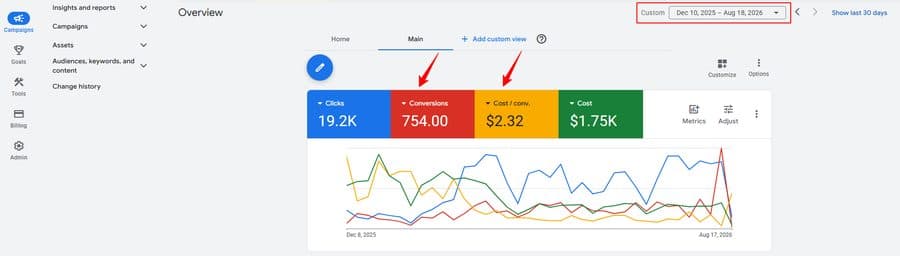
This is one account over one reporting period, not a benchmark. Those conversions are not being claimed as confirmed bookings, completed trips or qualified booking enquiries.
Transportation Google Ads: how Adlyvo works with transportation businesses
How Adlyvo approaches transportation lead generation
- Understand the service and its coverage.
- Identify high-intent transport demand.
- Account for pickup, destination and route context.
- Structure meaningful intent separately where appropriate.
- Connect relevant landing experiences.
- Track calls and booking enquiries.
- Distinguish meaningful conversion actions from weaker ones.
- Review search terms.
- Use enquiry-quality feedback where reliable data exists.
- Optimize around measurable outcomes.
Google Ads for transportation services: the full guide
How Adlyvo works as a Google Ads specialist
Frequently Asked Questions
What is transportation lead generation?
The process of turning demand for a transport service into booking enquiries a business can assess and act on, covering traffic, landing pages, capture, tracking, qualification and follow-up.
How can transportation businesses generate more booking enquiries?
By reaching people actively searching for the service they offer, sending them to relevant pages, making contact easy, tracking what happens and responding consistently. No single tactic guarantees bookings or trips.
Does Google Ads work for transportation lead generation?
It can, because it reaches people at the moment they search. Results depend on search intent, location and route coverage, structure, landing-page relevance, tracking, enquiry quality and follow-up, and are not guaranteed.
How should locations and routes be targeted?
To match the pickup areas, destinations and routes the business can realistically serve, with places and journeys it does not cover excluded and search terms reviewed to catch the rest. The business defines its coverage, and there is no universal radius.
Should immediate and scheduled transport intent be handled differently?
Often, because near-term enquiries favour a fast call path and clear information while scheduled ones suit a booking request and more detail. Not every enquiry is urgent, so it should not be assumed.
Should transportation ads use dedicated landing pages?
Usually, yes. A page for the service and the location or route searched, with a clear phone number and booking request, is more relevant than a general homepage.
How should booking enquiries be tracked?
Calls, forms and booking requests should be recorded as separate, meaningful actions, with route and location context where practical, and kept distinct from weaker signals such as button clicks.
What is a qualified booking enquiry?
An enquiry that has been reviewed and fits the business: the right service, a pickup area, destination and route it covers, and a genuine intent to book. The business sets its own criteria.
Can phone calls and booking requests be tracked?
Yes. Calls from ads and from a website can be measured, a tapped number should be kept separate from a connected call, and submitted booking requests can be recorded as conversions. Options depend on the setup.
How quickly should transportation enquiries be followed up?
As quickly as the business can reliably manage, especially for near-term or high-intent enquiries. There is no universal figure, and the right standard depends on the service.
How much should a transportation business spend on lead generation?
There is no universal figure. It depends on the service, location, route coverage, competition, cost per click, conversion rate, target volume, qualification rate, booking capacity and business economics.
Should campaigns optimize for CPL or qualified booking enquiries?
Enquiry quality should lead the decision. A lower cost per lead does not automatically mean better booking enquiries, so cost is best read alongside qualification and booking outcomes.
Can Adlyvo manage an existing Transportation Google Ads account?
Yes. Work usually starts with an audit of the current structure, search terms, tracking and landing pages, so useful history is kept and you can see what is working before anything changes.
Related resources and services
Google Ads for transportation services guide
Google Ads qualified lead tracking guide
Google Ads call tracking guide